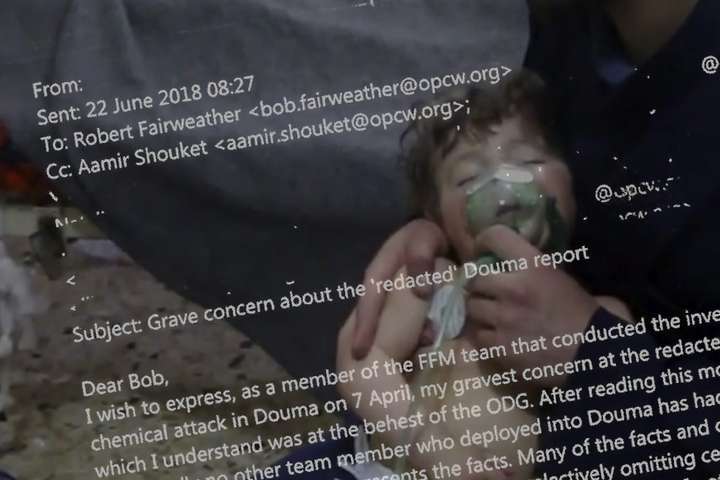

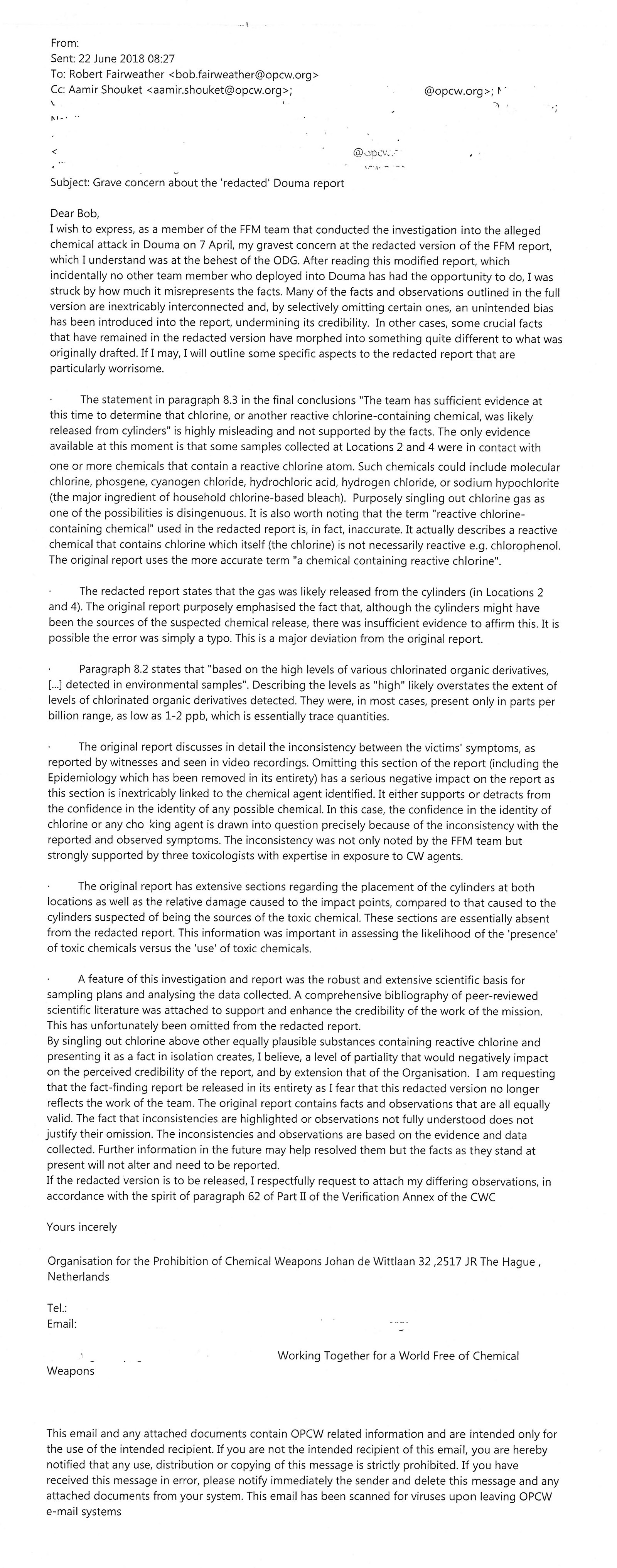
The Organisation for the Prohibition of Chemical Weapons sent a team of experts to investigate allegations that a chemical attack took place in the Syrian city of Douma on the 7th of April 2018. The author of the e-mail was a member of that team and claims the redacted preliminary version of the report, misrepresents the facts he and his colleagues discovered on the ground. The e-mail is dated 22nd of June. It is addressed to Robert Fairweather, Chief of Cabinet, and forwarded to his deputy Aamir Shouket and members of the fact-finding mission to Douma.
He says this misrepresentation was achieved by selective omission, introducing a bias which undermines the credibility of the report. Further it is claimed that crucial facts, that have remained in the redacted version: “...have morphed into something quite different to what was originally drafted.” This is said to have been done at the behest of the Office of the Director General (a post that was held by Turkish diplomat Ahmet Üzümcü at the time, he has since been replaced by Spaniard Fernando Arias).
Fog of war
The attack in question was widely attributed to the Syrian Army, based on reports by rebel forces that were present in Douma at the time, and this assertion was backed up by the United States, British and French governments. These three countries carried out air strikes against Syrian government targets in response, on the 14th of April 2018. This was before the fact-finding team had gained access to the site in Douma, the mission there was delayed for nearly two weeks by entrenched rebel fighters and subsequent clashes between the rebels and government forces that moved into the area.
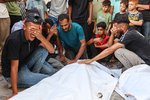
Upon arrival the team found much of the physical evidence, including the bodies of the deceased, was no longer available. It was alleged that 49 had died and up to 650 had been seriously affected by a weaponized chemical gas released in a specific area of rebel-held Douma on that day in April. Rebels claimed the gas came from cylinders dropped from aircraft, clearly implicating Syrian government forces who had complete air superiority.
“A major deviation from the original report”
The redacted interim report seemed to support these conclusions but the author of the released e-mail outlines some specific aspects of it which he considers: “particularly worrisome.”
Firstly, there is a statement in paragraph 8.3 in the final conclusions of the redacted report. It states that there is sufficient evidence to determine the presence of “chlorine, or another reactive chlorine-containing chemical.”
The e-mail points out that this was: “likely one or more chemicals that contain a reactive chlorine atom. Such chemicals could include… the major ingredient of household chlorine-based bleach. Purposely singling out chlorine gas as one of the possibilities is disingenuous.”
Inconsistent symptoms
The redacted report also removed context from a claim in the original draft, which concerned the likelihood of the gas having emanated from cylinders found at the scene in Douma. The original text is said to have purposely emphasised that there was insufficient evidence to affirm this being the case. This is “a major deviation from the original report” according to the author.
He also cites problems with paragraph 8.2 in the redacted version, which states: ”based on the high levels of various chlorinated organic derivatives detected in environmental samples”. This is said to overstate the case. According to the e-mail: “They were, in most cases, present only in parts per billion range, as low as 1-2 ppb, which is essentially trace quantities.”
One piece of evidence, which was shown on news networks across the world, was a video said to show victims being treated in a hospital in the aftermath of the attack in Douma. The symptoms shown were, however, not consistent with what witnesses reported seeing that day. A detailed discussion of this was apparently omitted from the redacted version of the OPCW report.
The e-mail states: “Omitting this secion of the report (including the Epidemiology which has been removed in its entirety) has a serious negative impact on the report as this section is inextricably linked to the chemical agent identified… In this case, the confidence in the identity of chlorine or any other choking agent is drawn into question precisely because of the inconsistency with the reported and observed symptoms. The inconsistency was not only noted by the fact-finding mission team, but strongly supported by three toxicologists with expertise in exposure to chemical warfare agents.”
Engineering report was removed
Yet another point of contention is the placement and condition of the cylinders reported to have contained the chemical agent. It has been alleged that their condition may not be consistent with having been dropped from the air, compared to damaged in the immediate surrounding area. This was discussed in an unreleased engineering report from OPCW that Wikileaks published in October 2019 and indicates it is unlikely the cylinders were air-dropped (see previous release: OPCW Whistleblower Panel on the Douma attack of April 2018)
Sections discussing this are largely absent from the redacted report. “This information was important in assessing the likelihood of the ‘presence’ of toxic chemicals versus the ‘use’ of toxic chemicals,” states the e-mail.
The author ends his letter with an appeal to the management to allow him to attach his differing observations to the document. He now wants to address the annual OPCW conference, along with other members of the fact-finding team, which begins on the 25th of November to present the findings that were withheld.
Media partnership and co-ordination: La Repubblica (Italy), Stundin (Iceland), Der Spiegel (Germany), Mail on Sunday (UK).














Athugasemdir