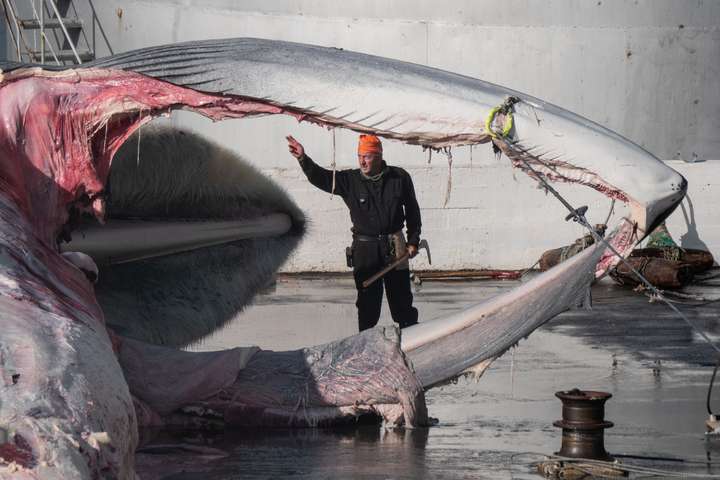


The Icelandic Food and Veterinary Authority (MAST) estimates that the hunting of large species of whales does not conform to animal welfare regulation goals. In a public announcement issued after the release of a special report on the supervision of Hvalur's hunting of fin whales last summer, the institution "deems it necessary to review all available documents and determine whether the hunting of large species of whales can conform to animal welfare regulation objectives".
MAST believes that the slaughter of "some of the larger whales by the Icelandic whaling industry has taken too long according to general objectives as set out by animal welfare regulation“.
However, the authority considers the industry to have employed "the best known practices when considering the circumstances under which the whaling activities have been practiced, and therefore the provision on hunting included in animal welfare regulation has not been broken."
Out of 148 hunted whales, 36 were shot more than once (24%). Five were shot three times and four were shot four times. One whale with a harpoon on its back was followed for five hours before being abandoned to its fate.
According to results from the supervision of the hunting of 58 animals:
35 whales were killed instantly (59%) according to the IWC's definition of when a whale is considered to be deceased (International Whaling Commission).
14 whales (24%) had to be shot more than once.
Two whales had to be shot four times, one of them dying within one hour and the other after two hours.

The supervisory report, which experts at MAST have been working on since last fall, is based among others on an on-board video recording required by law according to new regulation set by Food Safety Minister Svandís Svavarsdóttir in August last year. According to the new regulation, MAST is entrusted with organising regular supervision in order to ensure that animal welfare regulation is respected. The Directorate of Fisheries implemented the supervision which consisted among others of a video recording of hunting practices and their registration. Inspectors were also sent to report on the practices.
The minister can revoke the permit
In an interview with RÚV last summer, Svandís Svavarsdóttir deemed "inevitable" to put an end to whaling should it be found in violation of animal welfare regulation. The minister also believes it to be "uncontroversial" that whaling has no significant economic value and that there are few arguments in favour of authorising more whaling after Hvalur's catching permit has expired.
According to Hvalur's catching permit, which was issued in 2019 and will expire by the end of 2023, the minister of fisheries can revoke the permit should there be a breach of contract. Hvalur hf. is the only company with a whaling permit in Iceland.
148 fin whales were hunted down
148 fin whales were hunted in Icelandic waters last summer. The whaling season lasted a hundred days from june to october. According to recommendations by the Icelandic Marine and Freshwater Research Institute (Hafrannsóknarstofnun), the maximum allowed catch is 161 fin whales in the waters between Iceland and Greenland and 48 whales in the waters between east Iceland and the Faroe Islands.
"Crystal clear"
The animal welfare association Hard to Port kept a watchful eye on last year's whaling activity. The activists reportedly witnessed the protracted hunting and slow death of an animal that had been shot four times with harpoons, as well as the shooting of harpoons in an animal's flipper and the killing of pregnant whales.
"It is crystal clear in my view that if an industry relying on animal keeping or animal hunting cannot guarantee a merciful process when slaughtering animals, then such an industry has no future in a modern society," the Food Safety Minister declared when confronted with news of such practices last summer.
The supervision report by MAST was due to be released at an earlier date but Hvalur hf. made use of its right to object, delaying the release of the report on three occasions.
Hvalur hf. is preparing for the next whaling season and the company's ships are waiting at Reykjavik's shipyard.
BBC has reported that activists connected to Paul Watson, the founder of Sea Shepherd, were preparing for anti-whaling protests during the summer.
Veistu meira? Láttu okkur vita
Það tókst ekki að sækja formið. Reyndu aftur eftir augnablik.


Ýttu á + við höfund, fréttamál eða greinaröð til að fylgja því og fá tölvupóst þegar eitthvað nýtt kemur, einn á dag í mesta lagi. Því sem þú fylgir stjórnarðu á Minni síðu.











































Athugasemdir